01
Core takeaway
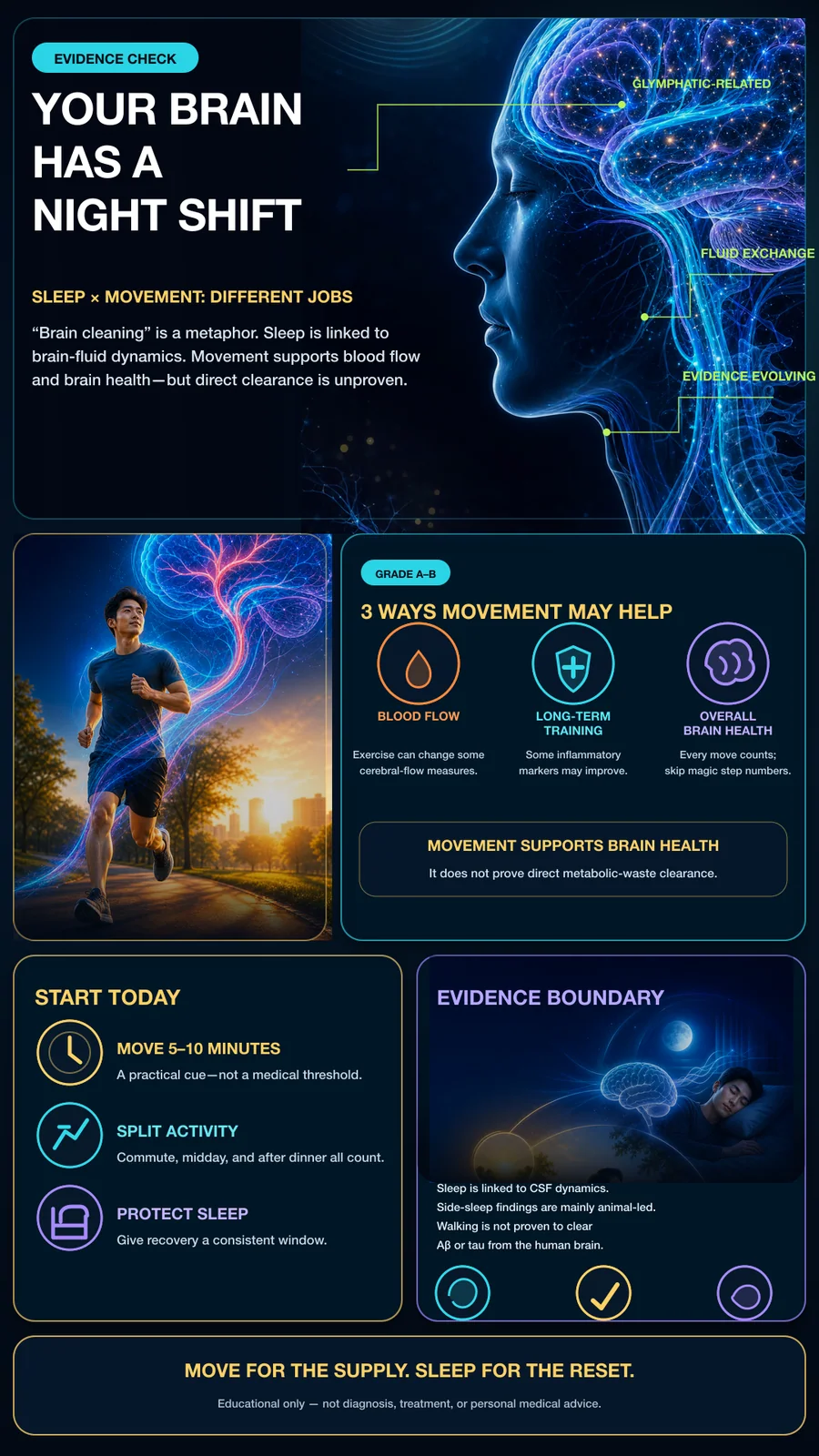
Sleep is linked to brain-fluid dynamics, while movement supports blood flow and overall brain health—but those are not the same mechanism.
02
How the science works
Fluid rhythms during sleep
During sleep, slow brain rhythms, blood flow, and cerebrospinal-fluid waves become coupled. Researchers are studying how this supports solute transport.
Transport is not household cleaning
Amyloid-beta and tau are normal proteins. The issue is abnormal buildup—not cartoon “toxins” waiting to be flushed away.
Movement supports the supply system
Exercise can affect cerebral blood-flow measures, and longer-term training may improve some systemic inflammatory markers.
Evidence cannot skip steps
That does not prove that a walk directly clears metabolic waste from the human brain.
03
Three practical actions
- 01
Break up long sitting
After 60–90 minutes of sitting, take a 5–10 minute movement break. Treat this as a practical cue, not a magic dose.
- 02
Spread movement across the day
Split activity across the day: walk part of your commute, take a midday loop, or stroll after dinner. Every move counts.
- 03
Protect a consistent sleep window
For adults 18–60, at least seven hours is a useful general benchmark; persistent sleep problems deserve professional care.
04
Evidence grades
A = strong evidence or broad consensus; B = moderate evidence; D = mainly animal mechanism; U = currently insufficient.
CLM-0001 · Core mechanism
Sleep is linked to cerebrospinal-fluid and glymphatic-related dynamics, but that does not prove disease prevention.
CLM-0002 · Core benefit
Research overall supports regular movement for brain health and shows that exercise can affect cerebral blood-flow measures.
CLM-0004 · Core evidence boundary
Everyday walking or regular exercise has not been proven to directly clear amyloid-beta, tau, or other metabolites from the human brain.
CLM-0005 · Safety boundary
The well-known side-sleeping result came mainly from anesthetized rodents and does not establish a universal human prescription.
05
Research limits
Human glymphatic measurement is still evolving. The well-known side-sleeping result came mainly from anesthetized rodents. Everyday walking has not been proven to directly clear amyloid-beta or tau from the human brain.
06
Original research and authoritative guidance
- Sleep, Cerebrospinal Fluid, and the Glymphatic System: A Systematic Review
Sleep Medicine Reviews · 2022-02-01
- The glymphatic system clears amyloid beta and tau from brain to plasma in humans
PubMed-indexed peer-reviewed study · 2026-01-27
- Effects of Physical Exercise Training on Cerebral Blood Flow Measurements
International Journal of Sport Nutrition and Exercise Metabolism · 2023-01-01
- Long-term exercise training and inflammatory biomarkers in healthy subjects
Frontiers in Psychology · 2023-09-18
- Physical activity
World Health Organization · 2024-06-26
- About Sleep
US Centers for Disease Control and Prevention · 2024-05-15
- The Effect of Body Posture on Brain Glymphatic Transport
Journal of Neuroscience · 2015-08-05
07
Education only
This material is for general education and science communication only. It does not provide diagnosis, treatment, prevention guarantees, prescriptions, or individualized medical advice. Sleep needs, exercise capacity, and medical risks vary. Seek qualified care for persistent insomnia, witnessed breathing pauses, excessive daytime sleepiness, chest pain, fainting, or other concerning symptoms.