01
Core takeaway
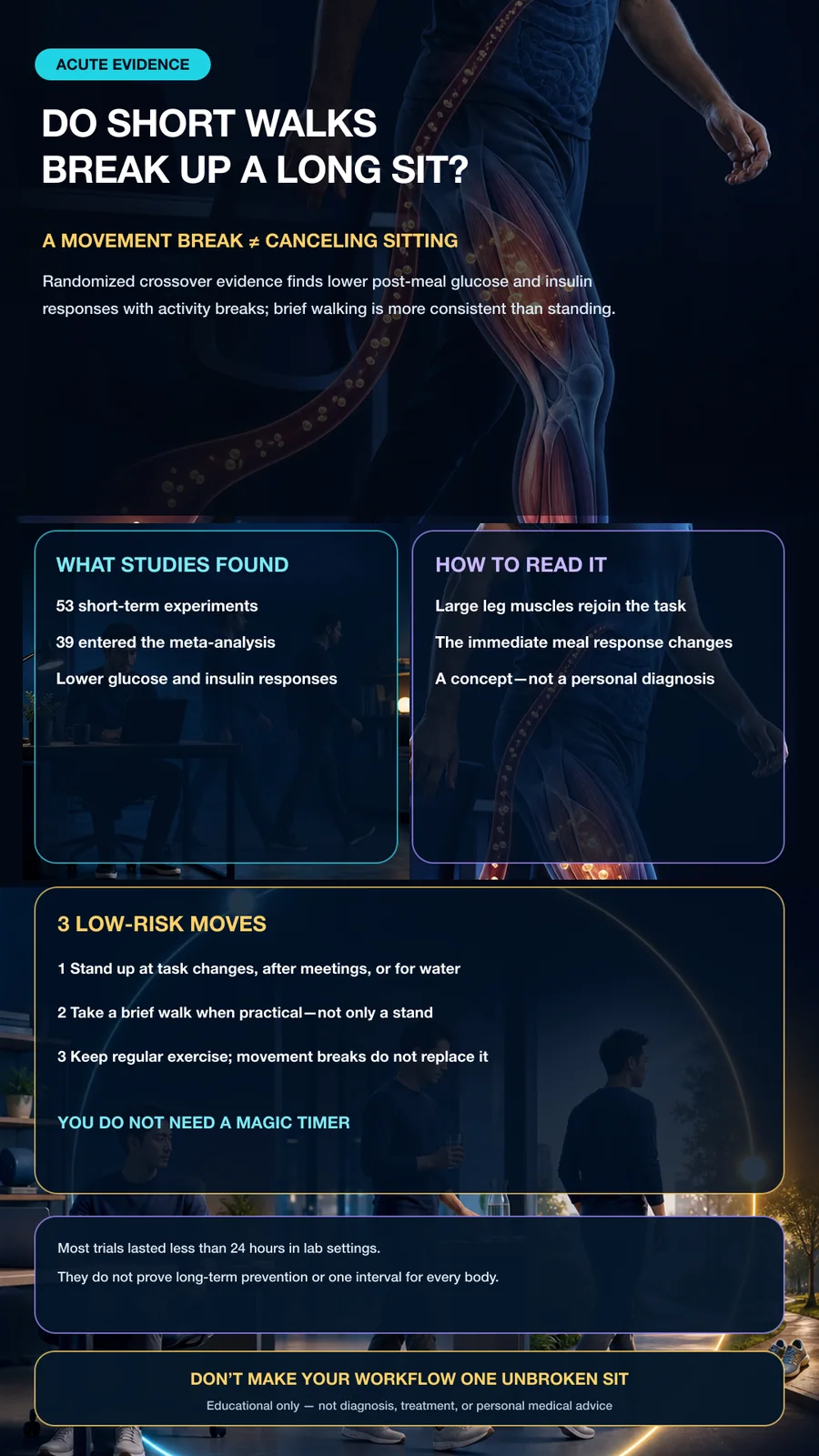
Randomized crossover evidence supports that brief activity breaks can acutely lower post-meal glucose and insulin responses compared with uninterrupted sitting, with walking generally more consistent than standing—but most studies are short laboratory trials, not proof of long-term prevention or one universal interval.
02
How the science works
Post-meal responses vary
After a meal, glucose and insulin responses vary with the meal, the person, and what the body is doing.
Recruit large leg muscles
A short walk recruits large leg muscles. Contraction-related glucose transport is a useful mechanism—not a personal glucose diagnosis.
What human trials observe
Randomized crossover trials find lower post-meal glucose and insulin responses during activity-break conditions than during uninterrupted sitting, on average.
Walking is not the same as standing
Walking is more consistent than standing alone in the limited direct comparisons, but the evidence does not create one timer for every body.
03
Three practical actions
- 01
Use natural transitions
Attach movement to natural transitions: finishing a task, ending a meeting, refilling water, or leaving lunch.
- 02
Take a brief walk when practical
Take a brief walk when practical. If walking is not accessible, start by reducing long unbroken sitting within your ability.
- 03
Keep regular exercise
Keep regular aerobic and strength activity. A few workday walks are a complement, not a replacement.
04
Evidence grades
A = strong evidence or broad consensus; B = moderate evidence; D = mainly animal mechanism; U = currently insufficient.
CLM-0012 · Core acute effect
Randomized crossover evidence supports that brief activity breaks can acutely lower post-meal glucose and insulin responses compared with uninterrupted sitting.
CLM-0013 · Walking comparison and mechanism
Research suggests brief walking is more consistent than standing alone for acute post-meal glucose and insulin outcomes; contraction-related glucose transport is a plausible mechanism.
CLM-0014 · Core evidence boundary
Activity breaks do not cancel sitting, prove long-term disease prevention, or replace regular exercise; current acute trials also do not establish one interval for everyone.
05
Research limits
Most evidence comes from laboratory randomized crossover trials lasting less than 24 hours; long-term adherence, clinical outcomes, and free-living effects remain uncertain. iAUC and standardized mean differences are group-level research measures, not personal continuous-glucose traces or diagnoses. The evidence does not establish 15, 20, or 30 minutes as a universal medical threshold. Activity breaks cannot cancel a day of sitting, replace regular exercise, guarantee weight loss, or prove prevention of diabetes or cardiovascular disease.
06
Original research and authoritative guidance
- The Acute Effects of Interrupting Prolonged Sitting With Regular Activity Breaks on Postprandial Glucose and Insulin in Adults: A Systematic Review and Meta-Analysis
Obesity Reviews · 2026-05-03
- Effects of Interrupting Prolonged Sitting with Physical Activity Breaks on Blood Glucose, Insulin and Triacylglycerol Measures: A Systematic Review and Meta-analysis
Sports Medicine · 2020-02-01
- The Acute Effects of Interrupting Prolonged Sitting Time in Adults with Standing and Light-Intensity Walking on Biomarkers of Cardiometabolic Health in Adults: A Systematic Review and Meta-analysis
Sports Medicine · 2022-08-01
- Breaking up prolonged sitting reduces postprandial glucose and insulin responses
Diabetes Care · 2012-05-01
- WHO guidelines on physical activity and sedentary behaviour
World Health Organization · 2020-11-25
- 中国公民健康素养——基本知识与技能(2024年版)
中华人民共和国国家卫生健康委员会 · 2024-05-29
- Exercise, GLUT4, and skeletal muscle glucose uptake
Physiological Reviews · 2013-07-01
07
Education only
This content is for general education only. It does not provide diagnosis, treatment, glucose-management plans, or personalized exercise advice. The person, glucose-like particles, vessel ribbon, and response waves are conceptual visuals—not scans, continuous glucose-monitor data, or medical records. People with symptoms, mobility limits, pregnancy, postoperative restrictions, hypoglycemia risk, or relevant medical conditions should follow qualified professional guidance.