01
Core takeaway
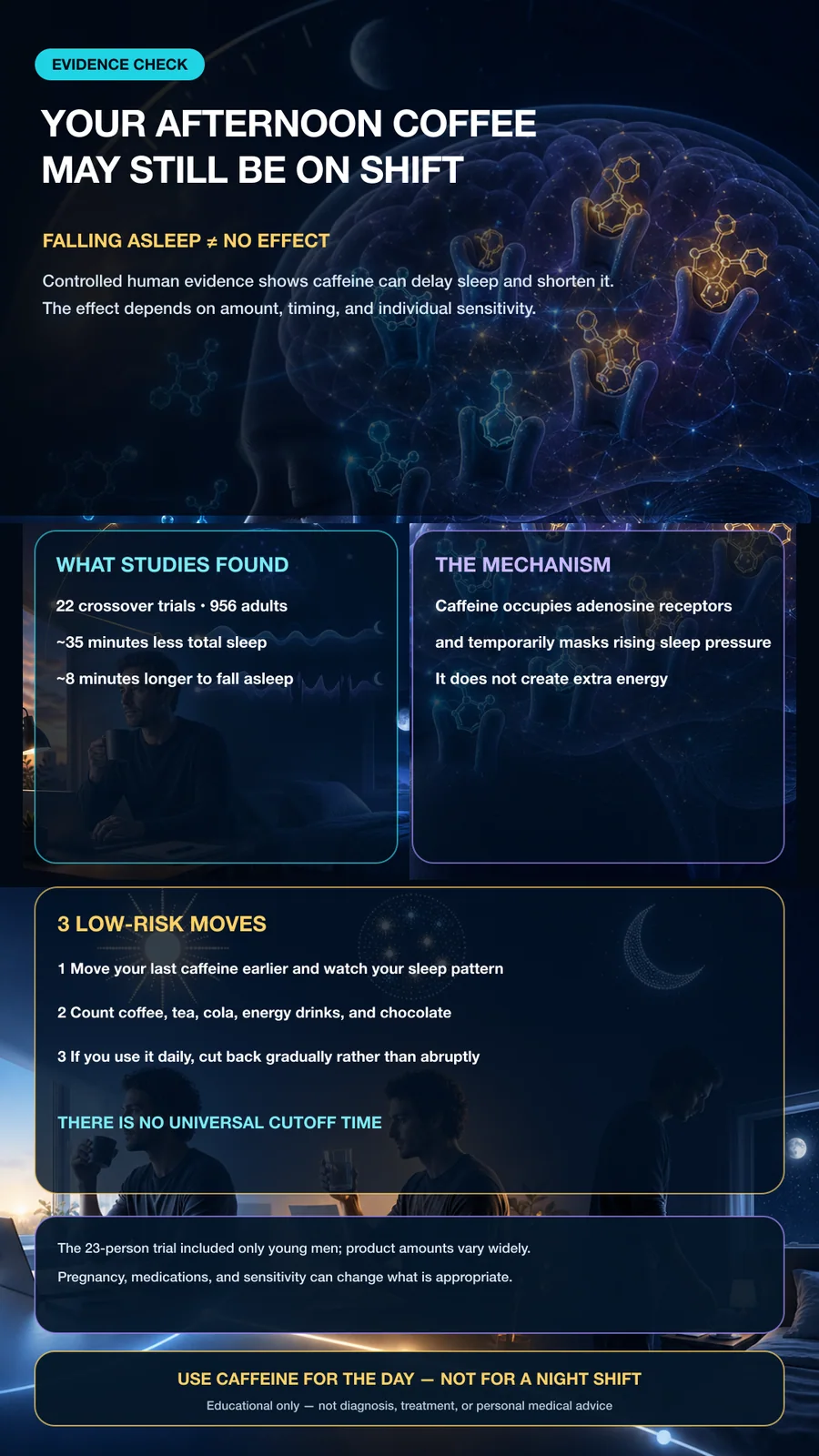
Controlled human evidence shows that caffeine can delay and shorten sleep, but the effect depends on amount, timing, and individual sensitivity—so there is no universal cutoff time.
02
How the science works
How sleep pressure builds
Sleep pressure generally rises the longer you stay awake, partly through adenosine signaling.
Caffeine masks a signal; it does not create energy
Caffeine temporarily occupies adenosine receptors and masks part of the sleepy signal. It does not create extra energy or treat the cause of fatigue.
What controlled human studies found
A 2025 meta-analysis of 22 crossover trials and 956 healthy adults found about 35 minutes less total sleep, roughly 8 minutes longer to fall asleep, and a 4.74-percentage-point drop in sleep efficiency on average. These are group averages, not individual predictions.
Amount, timing, and sensitivity
In a small randomized crossover trial of 23 young men, 400 mg had greater objective sleep effects closer to bedtime. A 100 mg dose four hours before bed showed no significant effect in that sample, but this cannot establish universal safety or a universal cutoff.
03
Three practical actions
- 01
Move the last serving earlier
If sleep seems sensitive, move your last caffeine earlier and watch your sleep pattern over several days instead of copying one universal clock time.
- 02
Count every source
Coffee, tea, cola, energy drinks, and chocolate can all contribute. Decaf does not necessarily mean zero caffeine.
- 03
Reduce gradually
If you use caffeine every day and want less, reduce it gradually; abrupt stopping can be unpleasant.
04
Evidence grades
A = strong evidence or broad consensus; B = moderate evidence; D = mainly animal mechanism; U = currently insufficient.
CLM-0008 · Core effect
Controlled human evidence overall supports that caffeine can shorten total sleep, reduce sleep efficiency, and delay sleep onset on average, while individual effects vary.
CLM-0009 · Dose and timing boundary
Research suggests caffeine's sleep effects depend on amount and timing; one small trial cannot define a universally safe dose or cutoff time.
CLM-0010 · Action boundary
Sensitivity and caffeine clearance vary widely, so there is no universal cutoff time; if sleep is affected, moving the last intake earlier and observing your sleep pattern is a low-risk approach.
CLM-0011 · Supporting safety guidance
Caffeine comes from more than coffee; regular users who want to cut back can generally tolerate a gradual reduction better than stopping abruptly.
05
Research limits
Meta-analyses report group averages, not individual outcomes. The direct timing trial included only 23 young men and cannot be generalized to women, pregnancy, older adults, adolescents, chronic illness, or medication use. Capsule doses describe research methods, not intake prescriptions; real drinks vary widely. Falling asleep also does not prove that objective sleep was unaffected.
06
Original research and authoritative guidance
- Age- and dose-specific effects of caffeine on sleep: A meta-analysis of controlled crossover trials
Sleep Medicine · 2025-12-01
- Dose and timing effects of caffeine on subsequent sleep: a randomized clinical crossover trial
Sleep · 2025-04-01
- The effect of caffeine on subsequent sleep: A systematic review and meta-analysis
Sleep Medicine Reviews · 2023-06-01
- Spilling the Beans: How Much Caffeine is Too Much?
U.S. Food and Drug Administration · 2024-08-28
- 全国爱卫办发布睡眠健康核心信息及释义
中华人民共和国国家卫生健康委员会 · 2025-03-21
07
Education only
This material is for general education and science communication only. It is not diagnosis, treatment, prescription, or individualized medical advice. Study doses describe research methods and are not intake recommendations. Seek qualified advice for pregnancy, breastfeeding, medication questions, palpitations, anxiety, or persistent insomnia.