01
Core takeaway
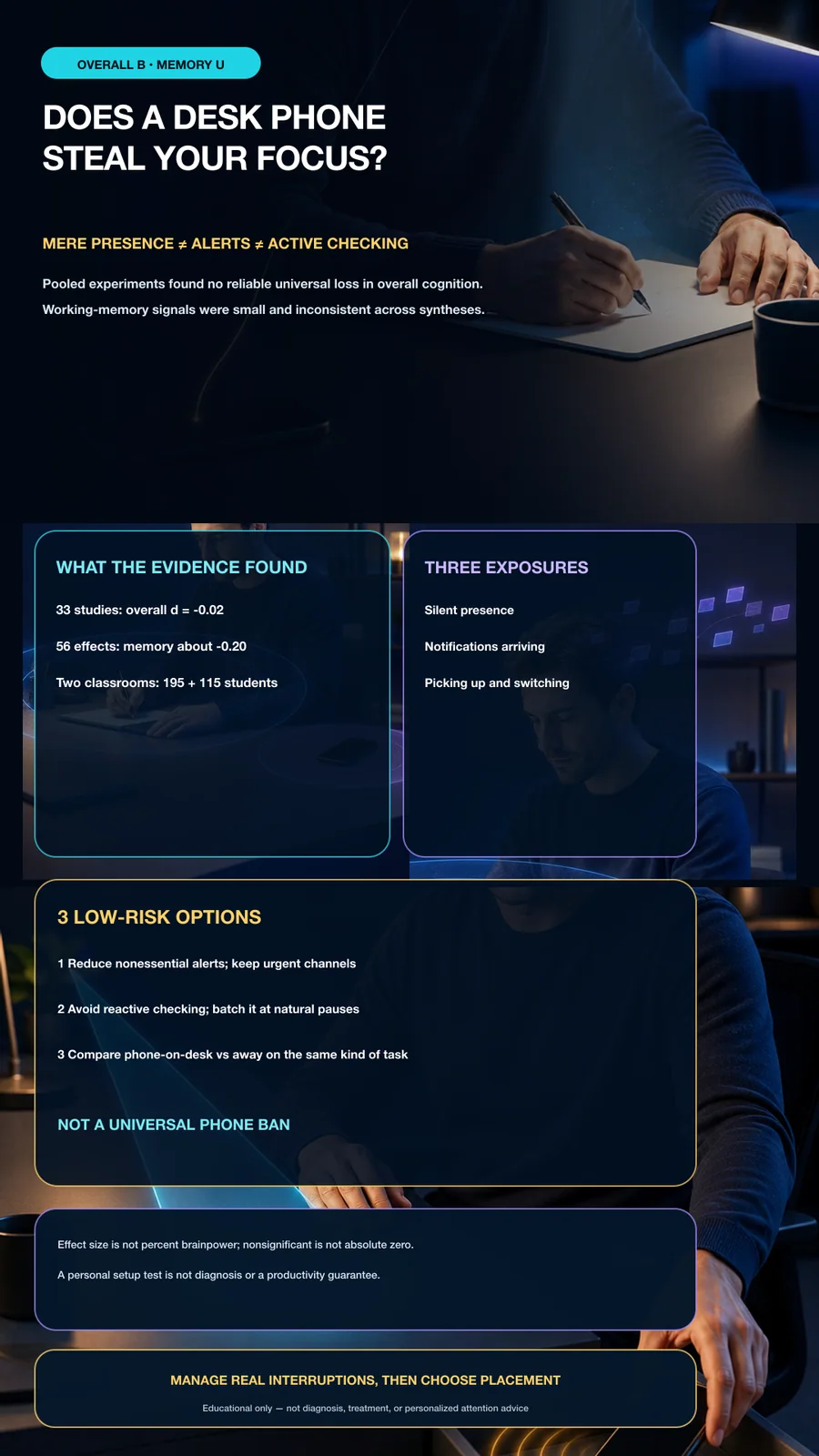
Pooled human experiments do not show that a silent, unused smartphone merely sitting on a desk reliably lowers overall cognitive performance for everyone. Working memory may show a small effect, but syntheses disagree, while notifications and active checking are different exposures.
02
How the science works
The pooled overall effect is near zero
Hartanto and colleagues pooled 33 studies, 53 samples, and 166 effect sizes. The overall effect was d=-0.02, near zero.
Working memory still shows a small signal
Different meta-analyses found small negative working-memory effects, but methods, tasks, and cognitive domains differ, so the findings do not fully agree.
A notification is a different exposure
Silent presence, a sound or pop-up alert, and active checking must be separated. Notification experiments observe brief processing disruption.
A lab task is not all-day productivity
Most evidence comes from short human experiments. Classroom and young-adult findings do not establish effects on adult coding, writing, or long-form work.
03
Three practical actions
- 01
Reduce nonessential alerts
Reduce nonessential alerts during demanding work while preserving notifications needed for on-call, caregiving, emergency, or accessibility needs.
- 02
Avoid reactive checking
Manage interruptions that actually arrive, and avoid picking up the device reactively for irrelevant prompts.
- 03
Compare the same kind of task
Compare phone-on-desk and phone-away using the same kind of task, tracking errors, completion, and felt distraction. It is a reversible setup test, not diagnosis.
04
Evidence grades
A = strong evidence or broad consensus; B = moderate evidence; D = mainly animal mechanism; U = currently insufficient.
CLM-0024 · Core overall-effect boundary
Pooled human experimental evidence does not show that the mere presence of a silent, unused smartphone reliably lowers overall cognitive performance for everyone.
CLM-0025 · Working-memory uncertainty
Some meta-analyses suggest a small negative effect of smartphone presence on working memory, but conclusions differ across syntheses and cognitive domains.
CLM-0026 · Notification-exposure boundary
Mere presence, receiving a notification, and active phone use are different exposures; notification experiments suggest brief processing disruption, not a fixed all-day productivity loss.
CLM-0027 · Low-risk workspace options
For focus-demanding work, reducing nonessential notifications, avoiding active checking, and comparing performance on your own key task are low-risk options; moving the phone to another room is not a universal medical prescription.
05
Research limits
The evidence comes mainly from short human experiments and experimental or quasi-experimental meta-analyses, not long-term real-world productivity trials. Primary studies were often small, underpowered, non-preregistered, not double-blind, and heterogeneous. Nonsignificant results do not prove that phones never matter; working memory remains uncertain. Effect sizes are not percentages of brainpower, and roughly 6.7 seconds is not a fixed loss per alert.
06
Original research and authoritative guidance
- The Effect of Mere Presence of Smartphone on Cognitive Functions: A Four-Level Meta-Analysis
Technology, Mind, and Behavior · 2024
- Does the Mere Presence of a Smartphone Impact Cognitive Performance? A Meta-Analysis of the “Brain Drain Effect”
Media Psychology · 2024
- Does the mere presence of smartphones impact cognition in the high school classroom?
Cyberpsychology: Journal of Psychosocial Research on Cyberspace · 2025
- Attention hijacked: How social media notifications disrupt cognitive processing
Computers in Human Behavior · 2026-06
- The attentional cost of receiving a cell phone notification
Journal of Experimental Psychology: Human Perception and Performance · 2015-08
- “Phone in the Room, Mind on the Roam”: Investigating the Impact of Mobile Phone Presence on Distraction
European Journal of Investigation in Health, Psychology and Education · 2025-05-08
07
Education only
This content is general science education. It does not diagnose attention disorders, smartphone addiction, anxiety, or any condition; it does not provide treatment or guarantee that a phone-placement setup will improve productivity. Seek qualified help when persistent attention difficulties materially affect daily functioning. On-call, caregiving, emergency, and accessibility needs take priority over generic workspace advice.