01
Core takeaway
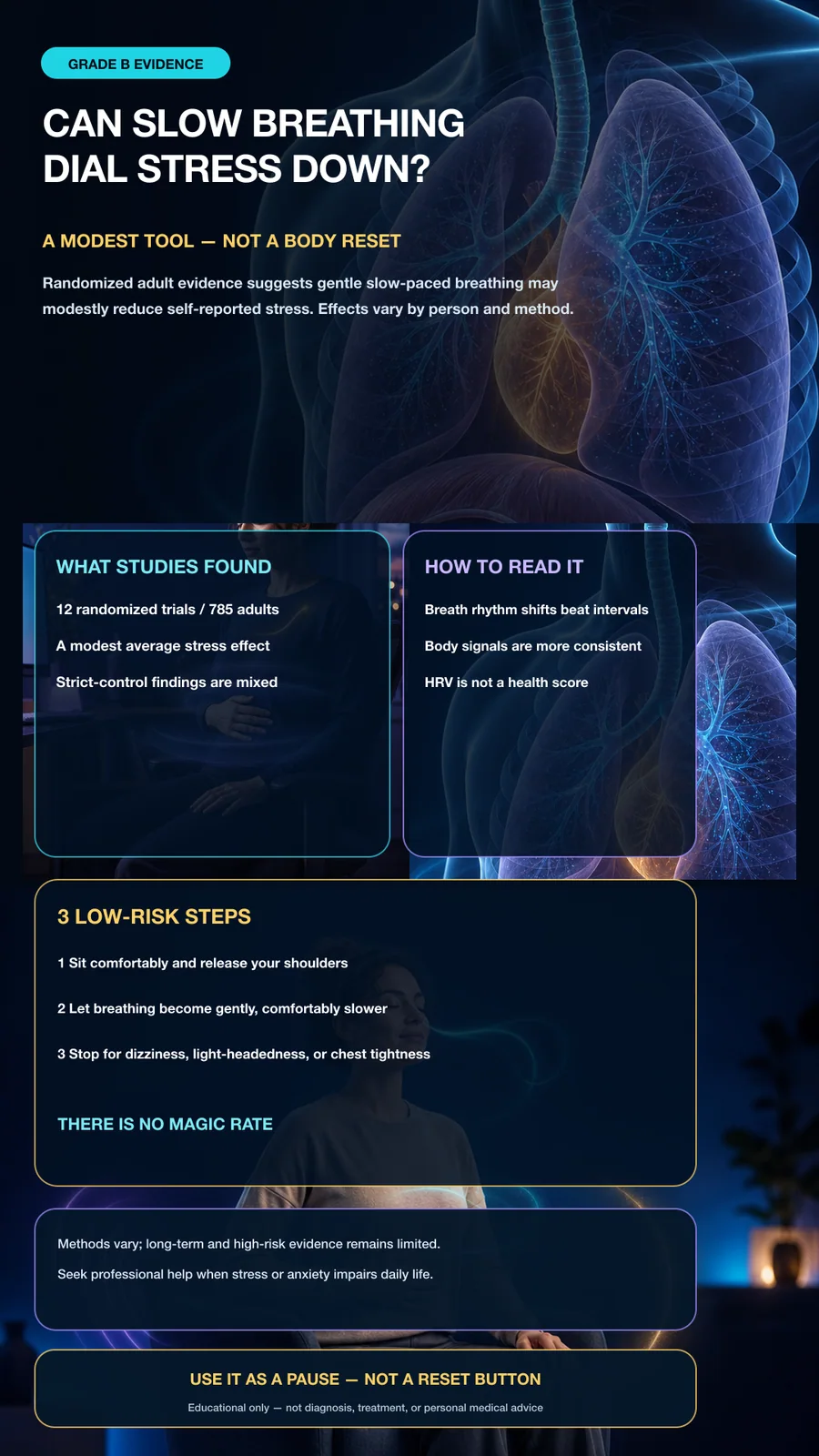
Adult evidence suggests gentle slow-paced breathing can shift some short-term heart-rate or HRV measures and may modestly reduce self-reported stress, but effects vary and it does not replace professional assessment or treatment.
02
How the science works
Rhythm shifts short-term physiology
Breathing rhythm changes short-term beat-to-beat physiology. That is not a “vagus switch.”
The average effect is modest
A meta-analysis of 12 randomized trials and 785 adults found a modest average reduction in self-reported stress, with substantial differences across methods and groups.
Stricter controls are not uniformly positive
A 400-person credible-control trial did not find about 5.5 breaths per minute superior to 12, and daily-life results varied by analysis.
HRV is not a health score
Body signals and subjective calm do not always move together. HRV varies with breathing, posture, devices, and analysis.
03
Three practical actions
- 01
Settle into a stable position
Sit or stand comfortably, release your shoulders, and do not force a bigger breath.
- 02
Slow down gently
Let breathing become gently and comfortably slower. Skip the perfect count or ratio.
- 03
Stop if uncomfortable
Stop and breathe normally for dizziness, light-headedness, or chest tightness. Seek professional help when symptoms keep impairing daily life.
04
Evidence grades
A = strong evidence or broad consensus; B = moderate evidence; D = mainly animal mechanism; U = currently insufficient.
CLM-0015 · Core subjective stress effect
Randomized adult evidence suggests breathwork may modestly reduce self-reported stress on average, but effects are small and strict-control or real-world findings are not uniformly positive.
CLM-0016 · Short-term physiology boundary
Slow-paced breathing shows more consistent short-term effects on heart rate and some HRV measures than on subjective negative emotion; these shifts are not treatment outcomes.
CLM-0017 · No universal breathing rate
Current human evidence does not establish one best breathing rate, inhale-to-exhale ratio, or duration for everyone.
CLM-0018 · Safety guidance
Breathing practice should feel gentle, comfortable, and unforced; stop or return to normal breathing for dizziness, light-headedness, or chest tightness.
CLM-0019 · Professional care boundary
Breathing exercises do not replace professional assessment or treatment when stress or anxiety persists and impairs daily functioning.
05
Research limits
Core evidence comes mainly from general or nonclinical adults, average effects are small, and breathing methods, rates, duration, controls, and outcomes vary. Most studies are short, with limited long-term functional, clinical, and adverse-event data. About 5.5 breaths per minute showed no specific advantage in a credible-control trial; that argues against a magic rate, not that every breathing practice is ineffective.
06
Original research and authoritative guidance
- Effect of breathwork on stress and mental health: A meta-analysis of randomised-controlled trials
Scientific Reports · 2023-01-09
- The Effect of Slow-Paced Breathing on Cardiovascular and Emotion Functions: A Meta-Analysis and Systematic Review
Mindfulness · 2024-01-02
- Brief structured respiration practices enhance mood and reduce physiological arousal
Cell Reports Medicine · 2023-01-17
- Effect of coherent breathing on mental health and wellbeing: a randomised placebo-controlled trial
Scientific Reports · 2023-12-13
- The immediate perceived and physiological stress-lowering effect of slow-paced breathing in daily life
Psychology & Health · 2026-04-13
- Doing What Matters in Times of Stress: An Illustrated Guide
World Health Organization · 2020-04-29
- Stress Management
American Heart Association ·
- Breathing exercises for stress
NHS · 2026-06-12
- Stress
World Health Organization · 2026-03-30
07
Education only
This content is for general education only. It does not diagnose or treat anxiety or any other mental-health condition, and it does not provide a personalized breathing program. Keep practice gentle and unforced; stop and breathe normally for dizziness, light-headedness, or chest tightness. Seek advice first for relevant heart or lung conditions, and seek qualified help when stress or anxiety persistently impairs daily functioning.